





How to Spot Hazardous Trees Early
- Gary Zimmerman - Certified Arborist - Tree Masters
- 7 hours ago
- 6 min read
A tree does not have to fall to be dangerous. In North Texas, many hazardous trees give off warning signs long before a limb drops on a roof, blocks a driveway, or damages a fence line after a storm. Knowing how to spot hazardous trees can help you act before a small problem turns into a major safety issue.
That matters whether you are a homeowner watching over a backyard shade tree or a property manager responsible for parking lots, walkways, and tenant safety. The challenge is that tree risk is not always obvious. Some defects are easy to see from the ground, while others are hidden inside the trunk, below the soil line, or high in the canopy.
How to spot hazardous trees on your property
Start by looking at the whole tree, not just the part that concerns you most. A dead limb over the driveway is a problem, but so is a root issue that weakens the entire tree. Step back and look at the shape, lean, canopy density, trunk condition, and the ground around the base.
A healthy tree usually has a balanced structure for its species, a full canopy during the growing season, and a trunk without major cracks or decay. A hazardous tree often shows stress in more than one area at the same time. When multiple warning signs appear together, the risk goes up.
Dead or hanging limbs
One of the clearest red flags is dead wood. Large dead branches can break without much warning, especially during high winds, heavy rain, or summer storm activity common across Dallas-Fort Worth. If you see limbs without leaves during the growing season, bark falling away, or branches that snap easily, those sections may already be dead.
Hanging limbs deserve immediate attention. A branch that has partially failed and is caught in the canopy can come down later with very little force. These are especially dangerous over homes, streets, sidewalks, play areas, and commercial access points.
Cracks, splits, and weak branch attachments
A crack in the trunk or a major limb is never something to ignore. Some cracks are fresh and obvious, while others open and close over time. Vertical cracks, splitting unions, and limbs attached with included bark can all point to structural weakness.
Included bark happens when two stems grow tightly together and trap bark between them instead of forming a strong connection. From the ground, that union may look tight, but it can be far weaker than it appears. In storm conditions, those stems are more likely to separate.
Cavities and decay
A hollow area, cavity, or soft spot in the trunk can signal internal decay. Not every hollow tree is an immediate failure risk, but decay reduces the amount of sound wood supporting the tree. The location and size of the defect matter. A small cavity in one area may be manageable, while decay at the base of the trunk or in a major scaffold limb can be much more serious.
Mushrooms or fungal growth near the trunk flare or root zone are another warning sign. Fungi often indicate decaying wood below the surface. If you see conks, shelf fungi, or repeated mushroom growth around the same tree, it is worth having the tree evaluated.
Root problems are easy to miss
Some of the most dangerous tree defects start below ground. Roots anchor the tree and help support its weight. When root systems are damaged, the whole tree becomes less stable, even if the canopy still looks fairly normal.
Watch for heaving soil, exposed roots that appear broken, recent trenching, or construction activity near the base. Soil compaction, grade changes, and root cuts from utility or landscaping work can all weaken a tree over time. In many cases, a tree with root damage declines gradually and then fails suddenly during a storm.
A leaning tree can also point to root failure, but context matters. Some trees naturally grow with a slight lean and remain stable for years. What raises concern is a new lean, a worsening lean, or a lean combined with cracked soil, lifted roots, or canopy decline.
Changes after storms or drought
North Texas weather puts trees under stress. Strong wind, saturated soil, heat, and drought can all expose weaknesses that were not obvious before. After a storm, inspect trees for fresh cracks, twisted limbs, broken tops, and branches hanging in the canopy.
Drought stress can be slower but just as serious. Repeated dry conditions weaken tree health, reduce vigor, and make trees more vulnerable to pests, disease, and branch failure. A tree may leaf out poorly, drop branches, or show dieback in the upper canopy months after a period of severe stress.
Warning signs in the canopy and trunk
When figuring out how to spot hazardous trees, pay attention to changes in growth and appearance. Trees often signal internal problems through the canopy first.
Sparse leaves, undersized leaves, dead branch tips, and sections of canopy that fail to leaf out can point to decline. If one side of the tree looks significantly weaker than the other, there may be a root, trunk, or vascular issue affecting that section.
On the trunk, look for peeling bark, deep wounds, old topping cuts, and areas that seem sunken or unusually soft. Trees that were improperly topped in the past often develop weak regrowth. Those new shoots can become large over time, but their attachment points may remain poorly connected and prone to failure.
Pests and disease can increase risk
Not every insect issue creates a hazardous tree, but some do weaken structure over time. Borer activity, disease-related cankers, and advanced wood decay can all reduce strength. If the tree is shedding bark, oozing sap, or showing widespread branch dieback, the problem may go beyond appearance.
This is where diagnosis matters. A tree can look rough but remain structurally stable, while another tree with fewer visible symptoms may be much closer to failure. That is why visual warning signs are useful, but they are not always the final answer.
Location matters as much as condition
A tree in poor condition in the back corner of a large lot presents a different level of risk than the same tree leaning over a house, sidewalk, playground, or parking area. Hazard is not just about whether a tree has defects. It is also about what that tree could hit if it fails.
For homeowners, the biggest concerns are usually roofs, vehicles, fences, utility lines, and family activity areas. For commercial properties, the stakes often include customer access, tenant safety, traffic flow, and liability exposure. Even a moderate defect may require faster action if the target area below is high use.
That is also why timing matters. Waiting through another storm season with a questionable tree near a structure is rarely a good gamble.
When a tree can be pruned and when it may need removal
Not every hazardous tree needs to come down. In some cases, proper pruning can reduce risk by removing deadwood, reducing end weight on stressed limbs, or correcting structural issues early. Cabling or bracing may also help in select situations, though that depends on the species, defect, age, and overall condition of the tree.
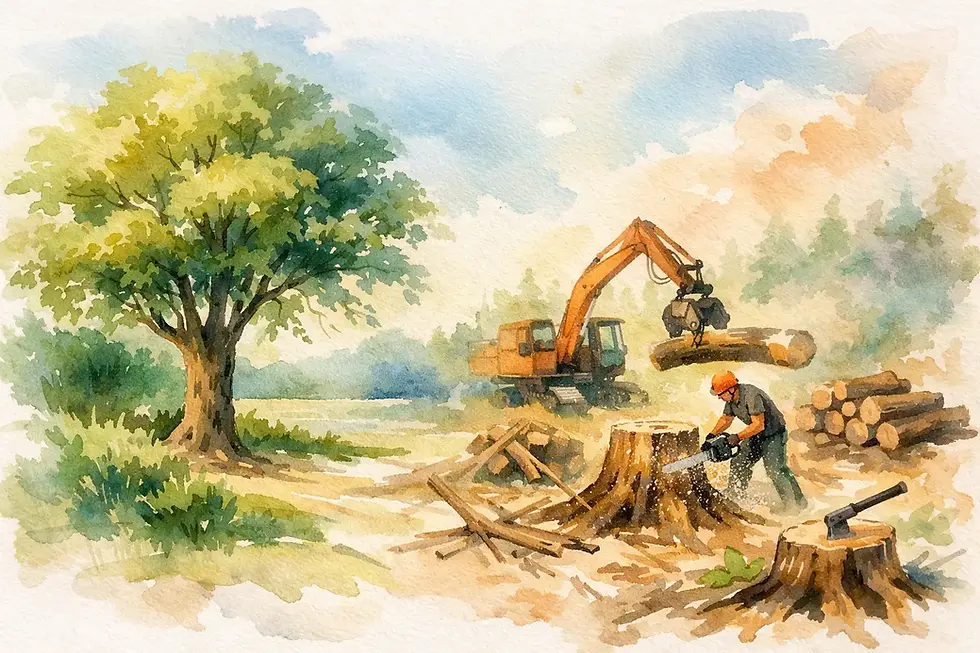
Other times, removal is the safer option. If the trunk is significantly compromised, root stability is failing, or decay is advanced in key structural areas, pruning may not solve the underlying problem. A large dead tree, a tree with major base decay, or one that has already partially uprooted often needs prompt removal.
The right call depends on the defect, the site, and the consequences of failure. That is where an experienced arborist can save you time, money, and risk.
When to call a professional
If you see a large dead limb, a fresh crack, a sudden lean, exposed roots lifting from the ground, or signs of decay at the base, it is time for a professional inspection. The same applies after major storms, especially if the tree is close to a structure or access area.
A qualified arborist can assess structural condition, identify hidden defects, and explain whether pruning, treatment, monitoring, or removal makes the most sense. For high-risk situations, especially involving storm damage or large trees over homes and commercial spaces, this is not a DIY decision.
Tree Masters Tree Service has seen firsthand how quickly a compromised tree can go from manageable to urgent in the DFW area. Fast evaluation and proper action are what protect people, property, and the trees worth preserving.
If a tree on your property has you second-guessing where you park, walk, or let people gather, trust that instinct. Catching a hazard early is almost always easier than dealing with the damage after the fact.


Comments