
🌳
Deadwood Removal
Removing dead, dying and broken limbs reduces hazards while improving the tree's health, appearance and long-term safety.

Professional tree trimming since 1988
Tree Masters provides careful, professional tree trimming designed to improve tree structure, remove hazardous deadwood and protect the long-term health and appearance of your trees. Every pruning recommendation is based on the tree, the property and what will provide the greatest lasting benefit.
Pruning With a Purpose
Trees should not be trimmed simply because branches exist. Every cut changes how a tree grows, responds to stress and supports its canopy. Proper pruning begins by identifying a clear reason for the work.
Trimming may be appropriate when dead, damaged or poorly attached branches create risk, when limbs interfere with structures or access, or when selective pruning can improve the tree’s long-term form and stability.
Our goal is not to remove as much foliage as possible. It is to make careful, purposeful cuts that address the concern while preserving the tree’s health, natural form and value.
Request an honest tree evaluation →
PROFESSIONAL TREE TRIMMING SOLUTIONS
Every property is different, and no two pruning projects are exactly alike. Whether your trees need structural pruning, clearance trimming, deadwood removal or canopy reduction, Tree Masters carefully evaluates every tree before making the first cut.
Removing dead, dying and broken limbs reduces hazards while improving the tree's health, appearance and long-term safety.

Selective pruning helps develop stronger branch structure, reduces future failure and encourages healthier tree growth.
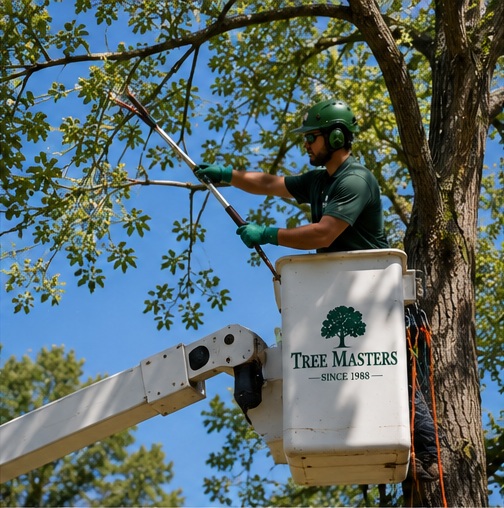
Branches growing too close to homes, roofs and structures are carefully pruned to maintain safe clearance without over-trimming.

Lower branches are selectively removed to improve visibility, pedestrian access, vehicle clearance and overall usability.

Strategic thinning improves light penetration and air movement while maintaining the tree's natural beauty and structural integrity.

Broken and storm-damaged limbs are carefully removed to restore safety and help the tree recover whenever possible.
Every tree deserves a different pruning plan. Proper trimming protects people, preserves tree health and enhances the beauty of your landscape for years to come.
A Thoughtful Pruning Process
Proper pruning begins with understanding the tree—not simply removing branches. Every recommendation is based on the tree’s species, health, structure, surroundings and the purpose of the work.
We inspect the tree’s health, structure, growth habits and surrounding property before deciding where pruning will provide the greatest benefit.
We identify whether the tree needs deadwood removal, structural pruning, clearance work, selective thinning or another focused approach.
Careful cuts are made to address the concern while preserving the tree’s natural form, healthy foliage and long-term structural integrity.
Branches and debris are removed, the property is cleaned and the completed work is reviewed whenever possible before the crew leaves.
Good pruning is measured by what remains—not how much is removed. Every cut should improve safety, structure, clearance or long-term tree health.
WHY HOMEOWNERS CHOOSE TREE MASTERS
Since 1988, homeowners throughout North Texas have trusted Tree Masters to care for mature trees with thoughtful pruning, honest recommendations and long-term tree health in mind.

Every pruning cut has a purpose. We avoid unnecessary trimming and focus on improving safety, structure and long-term tree health.

Healthy trees are valuable assets. Our recommendations are designed to preserve natural form, encourage healthy growth and minimize stress.

From hand pruners to aerial lifts, professional equipment allows our crews to make precise cuts safely and efficiently.

Every branch, twig and piece of debris is removed before we leave. Your property should look better than when we arrived.

Sometimes a tree doesn't need trimming. If we believe no work is necessary—or that another solution is better—we'll tell you.

For nearly four decades, Tree Masters has helped homeowners care for North Texas trees through thoughtful pruning, experience and integrity.
Real Work. Real North Texas Trees.
Thoughtful pruning can improve safety, structure, clearance and the overall appearance of a tree without sacrificing its natural form. These projects show the difference purposeful trimming can make.

Featured Project
This project required selective pruning to remove deadwood, improve clearance and preserve the tree’s natural shape while protecting the surrounding home and landscape.

Hazardous dead and broken limbs removed while preserving healthy canopy growth.

Branches selectively pruned away from roofs, walls and nearby structures.

Poorly attached and competing branches corrected to improve long-term form and stability.

Lower limbs selectively removed to improve access, visibility and usable space.
Frequently Asked Questions
Proper pruning depends on the tree, the season, the reason for the work and the condition of the canopy. Here are answers to some of the questions North Texas homeowners ask most often.
Trimming may be appropriate when a tree has dead or broken branches, limbs touching structures, poor branch attachments, clearance issues or structural problems that selective pruning can improve. We evaluate the tree first and recommend work only when there is a clear reason.
There is no single schedule that fits every tree. Species, age, condition, growth rate, location and previous pruning all matter. Some trees benefit from periodic maintenance, while others may need little or no pruning for several years.
The best timing depends on the species, the reason for pruning and the tree’s condition. Dead, broken or hazardous branches may require attention at any time, while other pruning is often scheduled during periods that reduce stress and support healthy recovery.
Proper pruning can improve safety, structure, clearance and long-term development. However, unnecessary or excessive trimming can stress a tree. The goal is to make only the cuts that provide a clear benefit.
We do not recommend topping as a routine pruning method. Topping can create weak regrowth, large wounds, decay and long-term structural problems. We use selective pruning methods designed to preserve the tree’s natural form and structural integrity.
Yes. Clearance pruning can create appropriate space around roofs, buildings, driveways, sidewalks and other areas while avoiding unnecessary removal of healthy foliage.
Yes. Branches, twigs and debris are removed according to the agreed scope, and the work area is cleaned before the crew considers the project complete.
In many cases, improvement is possible, but correction may need to happen gradually. We evaluate the tree’s current condition and explain what can realistically be improved without placing unnecessary stress on the canopy.
HEALTHY TREES. THOUGHTFUL PRUNING. SINCE 1988.
Whether your trees need routine maintenance, structural pruning, clearance trimming or an honest professional evaluation, we're here to help. We'll explain what we see, answer your questions and recommend the solution that's best for your trees—not simply the most expensive one.