




How to Assess Storm Damaged Trees Safely
- Gary Zimmerman - Certified Arborist - Tree Masters
- 13 minutes ago
- 5 min read
The morning after a North Texas storm, the damage is not always obvious from the street. A tree may still be standing, still leafed out, and still look "mostly fine" - while the trunk is split, the roots are lifting, or a heavy limb is hanging over a driveway, roof, or sidewalk. If you are wondering how to assess storm damaged trees, the first priority is simple: protect people and property before you think about cleanup.
Storm damage can turn a healthy tree into an immediate hazard, but it can also leave behind problems that do not show up until days or weeks later. That is why a careful assessment matters. For homeowners, that means knowing what you can safely observe from the ground. For commercial properties, HOAs, and managers, it also means identifying liability risks early and documenting conditions before anyone starts cutting.
How to assess storm damaged trees without taking risks
Start from a distance. Do not walk directly under broken limbs, leaning trunks, or trees touching utility lines. After high winds, hail, or saturated soil, trees can fail in stages. A branch that stayed up during the storm can still come down later.
Begin by scanning the whole site, not just the tree itself. Look for blocked access points, damage near buildings, fencing, parked vehicles, play areas, and public walkways. On commercial properties, pay special attention to entrances, tenant parking, perimeter drives, and any area where people may return before hazards are addressed.
Then look at the tree from the top down. A broken canopy is often the easiest sign to spot. Large hanging limbs, torn branch unions, and sections of the crown missing on one side can all point to structural failure. Even when the trunk looks intact, canopy loss can shift the tree's weight and make the remaining structure unstable.
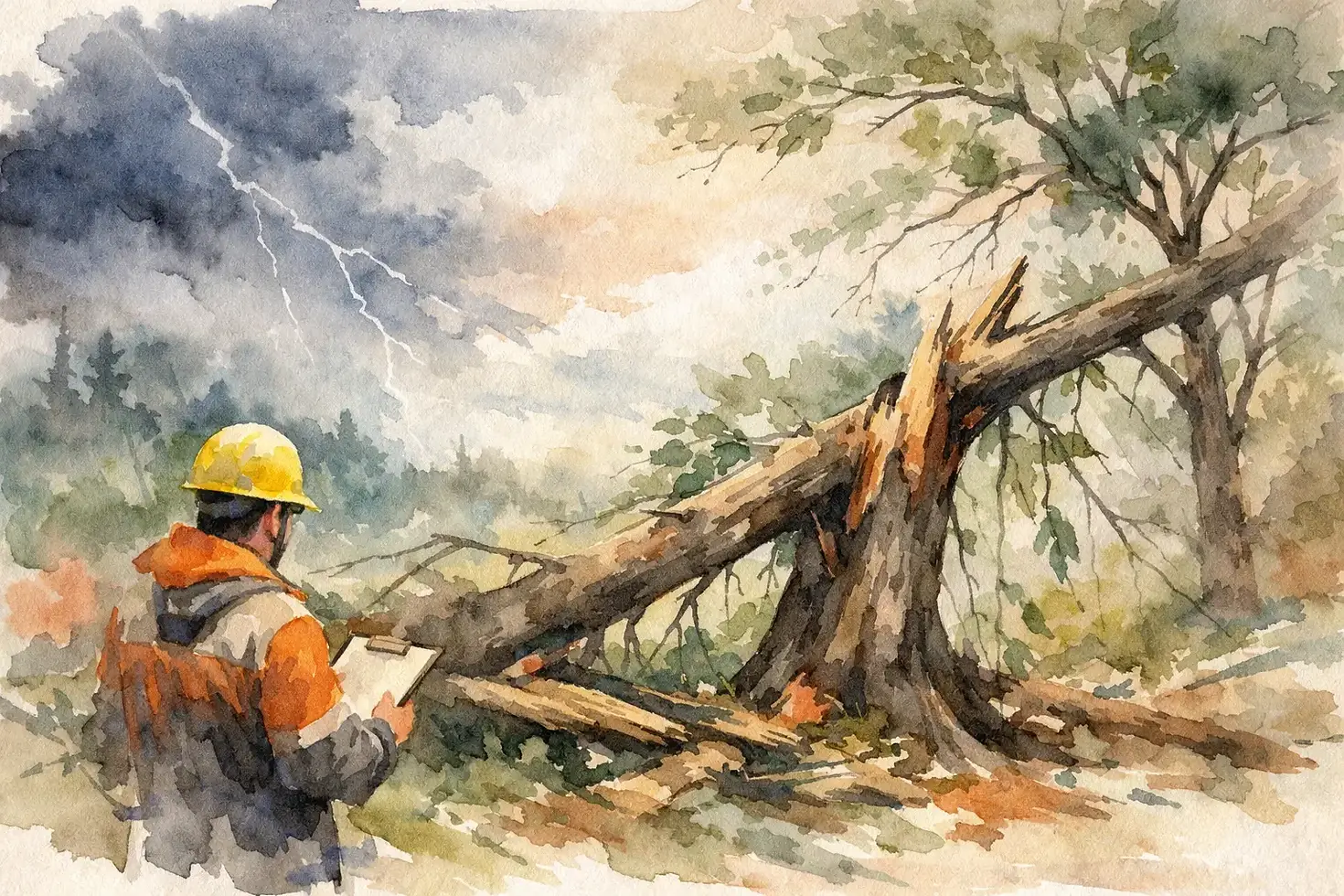
After that, check the trunk. Fresh cracks, long vertical splits, missing bark, and exposed wood are signs the tree absorbed more force than it could handle. A split trunk does not always mean immediate total failure, but it does mean the tree needs professional evaluation. The larger the crack and the closer it is to the base, the more serious the concern.
Finally, inspect the area around the base. Soil heaving, lifted roots, new leaning, or a mound forming on one side of the trunk can indicate root plate movement. In North Texas, heavy rain followed by wind can weaken root support quickly, especially in compacted soils or sites with previous construction damage.
The signs that usually mean immediate danger
Some storm damage should be treated as an emergency, not a watch-and-wait situation. If a tree or limb is on a power line, stay back and contact the utility provider immediately. Never try to move it yourself, and never assume a line is safe because it is not sparking.
A tree leaning toward a house, business, roadway, or occupied area is also urgent, especially if the lean is new. Trees often develop natural lean over time, but a sudden change after a storm is different. That usually points to root failure or compromised stability.
Large broken limbs still attached in the canopy are another high-risk condition. Arborists often call these hangers or widowmakers. They can fall without warning, and they are one of the most dangerous parts of storm cleanup.
If the trunk is split deeply, the root system is lifting, or the tree has partially fallen and is being held up by another tree, do not approach it. Those situations require trained crews, proper rigging, and insured equipment. This is where experience matters more than speed.
Damage that may not mean removal
Not every storm-damaged tree has to come down. That is one of the biggest misconceptions property owners have after severe weather. A mature tree with some limb loss may still be a good candidate for corrective pruning, weight reduction, cabling, or monitoring.
The decision depends on species, age, condition before the storm, percentage of canopy loss, trunk integrity, and target exposure. A valuable shade tree in a backyard may be worth preserving if the structural damage is limited and the root system is sound. On the other hand, the same level of damage near a busy commercial entrance may create too much liability to justify saving it.
This is also where poor cleanup decisions can make things worse. Cutting limbs randomly to "balance" a tree, topping the canopy, or making flush cuts can leave the tree weaker and more vulnerable in the next storm. Proper pruning after storm damage should reduce risk while supporting long-term recovery.
How to assess storm damaged trees at the root and trunk level
The root flare and lower trunk tell you a lot. If the soil is cracked in a semicircle around the base, if roots are exposed that were previously buried, or if the trunk now sits at a different angle, assume the root system has been compromised. Trees can sometimes survive partial root damage, but stability becomes the main question.
At the trunk, look for fresh wounds with jagged edges, bark peeling away, and seams that were not there before the storm. Old defects and new damage can combine into a much bigger problem. For example, a tree with a pre-existing cavity may tolerate normal weather for years, then fail once strong winds add torsion stress to a weakened trunk.
If you see mushrooms at the base, decayed wood, or hollow areas along with storm damage, the risk goes up. Storms often expose defects that have been developing quietly for a long time.
What to photograph and document
If the tree damaged a structure, vehicle, fence, or common area, take clear photos before cleanup starts, as long as you can do so safely from the ground. Photograph the full tree, the damaged sections, the base, and any impact points. On commercial sites, document nearby signage, sidewalks, parking spaces, and other public-use areas.
Basic documentation helps with insurance claims, maintenance records, and contractor communication. It also helps establish whether the damage appears limited to branches or involves the trunk and root system. That distinction often affects whether pruning, removal, or further arborist assessment is the right next step.
When a certified arborist should inspect the tree
A professional inspection is the smart move when the tree is large, near a target, historically valuable, or showing structural damage beyond simple broken twigs and minor limb loss. It is especially important when the tree appears stable at first glance but has hidden warning signs such as bark separation, soil movement, or canopy imbalance.
For commercial properties, a prompt inspection also supports risk management. If a damaged tree remains over a parking lot, sidewalk, or tenant access route, delaying action can create avoidable exposure. The same goes for HOAs and municipalities responsible for shared spaces.
Tree Masters Tree Service has worked across the Dallas-Fort Worth Metroplex since 1988, and this is exactly where trained assessment matters. Storm work is not just about cutting what fell. It is about determining what is still standing but no longer safe.
What not to do after storm damage
Do not climb the tree. Do not use a ladder near a damaged trunk or hanging limb. Do not operate a chainsaw from the ground on overhead branches, and do not attempt cleanup around energized lines.
It is also wise not to assume a tree is safe because the leaves are still green. A tree can remain alive for a period even after severe root or trunk failure. Visual vitality is not the same as structural stability.
And do not rush to remove every damaged tree without an informed assessment. In many cases, preserving the right tree is possible and worthwhile. In other cases, removal is the only responsible option. The difference comes down to training, inspection, and understanding the actual defect, not just the obvious mess left behind.
After a storm, the goal is not to make the property look normal as fast as possible. The goal is to make it safe, then make the right call for the long term. A careful assessment today can prevent a second failure tomorrow.


Comments